
I was 16. It was a pitch-perfect Kodiak day, and we were having our version of “fun.” The wind was blowing so hard that the rain moved in horizontal sheets across the deck, pulling jellyfish into raw threads of fire that laced across my cheeks and slid under my gear onto my neck. My legs braced at the knees against the stack with every swell, my arms burning and wet as I strained to hold the purse line tight while, at the same time, batting and heaving the leads into a tidy pile along the starboard side. Saltwater rained onto my cap and hood from the block as it dragged the net from the water directly over my head. The wind was blowing so hard that a seagull flapped in place a few feet from my shoulder, surging against the current as if tethered by a string; it turned a strange eye in my direction. I stared back. The rest of the crew kept their heads down and did their best to be invisible to the skipper. To my dad.
“WHAT THE FUCK!!”
Something had gone typically awry. The boat was probably drifting over the net, releasing fish over the corks. We were full pursing, so we had the purse line on the winch snaking down into the fish hold as we brought in the net from the other side. Hydraulics are handy, but very dangerous - as my dad was always reminding me, get your glove or raingear caught on that winch, and it’ll snap your whole body in half before it slows down. I liked the tension of full pursing: it was loud and every line was taut and groaning. I liked the hum of the hydraulics. I focused on that sound sometimes, when I wanted to relax.
“HAVE YOU GOT YOUR HEAD SO FAR UP YOUR ASS YOU CAN’T SEE ME?!”
My dad was a screamer, and currently, he was screaming at the top of his lungs, waving his arms in what was probably supposed to be a signal to the skiff man, but what looked like what it really was - rage gone silly and incoherent with its own volcanic force. It’s tough to say who endures more abuse - the skiff man or the deck crew. The skiff man is the easiest to blame when a set gets fucked up. On the other hand, she or he also has the benefit of distance, and can drown out the screaming with a little extra throttle. The deck crew - or, as they were known on my boat, “cretins” - get it in the face and have the pleasure of hearing everything word for word, which sometimes hurts, even if we are just useless swab monkeys with shit for brains.
My dad picked up a plunger pole just so he could heave it against the deck, then picked it up and heaved it again, apparently dissatisfied with the tinny clank it made against the noise of the winch and the wind and the engine rumble and the sputtering growl of the skiff.
“WHAT THE FLYING FUCKING SHIT DO YOU THINK YOU’RE DOING?!!” he screamed. “NO NO NO NO NO NO NO NO NO...”
After the screaming came histrionics. He pulled his long white beard in different directions. He gestured in agony at the heavens. He tore off his hat and threw it on the deck, kicking it and then putting it back on his head soaked in saltwater and gurry. He wind-milled his arms as if he would tear them out of their sockets, and then buried his face in his hands, shaking his head in a wild display of the burdens he bore, working with such imbeciles.
“YOU GET YOUR ASS AROUND THAT CORNER RIGHT FUCKING NOW YOU USELESS SON OF AN ASS-FUCKED WHORE!!”
His face was red and puffed out, like a boil ready to burst. Even his eyeballs turned red when he really went for it. I often wondered if there were a trick to this - maybe something he learned in the Army, an intimidation tactic. I sort of envied that level of commitment to an art, but I could clearly see the toll it took on one’s body. I remember thinking that he might have an aneurysm if he weren’t careful. I could swear there was smoke coming out his ears in symmetrical little white puffs, and an old red steam whistle blowing off the top of his head.
“GOD! FUCKING! DAMN! IT!”
He went through the different phases of sounds: the bellowing, the yelling, the high-pitched sarcastic pleading, and then finally went mute, jerking and hopping around the deck in a spasmodic, wordless rage. He began jumping up and down, stamping and kicking and pointing and looking for all the world like Rumpelstiltskin whose name has been guessed, damning the devil until the floor caved in - and then, it did.
Or at least that’s what I thought happened - it all went so quickly. In his explosion of anger, my dad had slipped and gone down the hole into which the winch was feeding the purse line; it was only about three feet across, but large enough for my dad’s foot, quickly followed by his other foot, and then the rest of him, to the waist. He caught himself with his upper arms, bellowed once like an angry bull, and then went strangely silent as the line continued to feed on top of him. Soon, he was half-buried in lead line, and half-dangling in the hold. The deckhand on the corks leaped over the stack, stumbling over the gear and mess on deck, and shut off the hydraulics. The relaxing hum stopped. My mother made some wordless noise of panic. I had a quick thought: “I think he’s dead.” And then I burst out laughing.
This wasn’t ordinary laughter. This wasn’t, “Holy shit - I didn’t see that coming,” laughter. This was all-out, gut-busting, pee-your-pants, wheezing, senseless laughter; this laughter hurt my face. I held onto the purse line and doubled over, my whole body shaking as I went soft in the knees. I was laughing so hard I couldn’t see, I couldn’t help. The deckhand and my mom were struggling to drag my dad out of the hold. He was conscious but confused, giving orders that were impossible to follow, wanting us to save the fish, save him, save whatthefuckever, all at the same time. I felt weak with relief, even as guilt and shock and comedy battled for the upper hand. I wasn’t relieved that he seemed to be okay. At that moment, I had been relieved that he was dead, simply because the screaming stopped. Some moments make no sense.
Somehow, we finished the set. He seemed to be injured, but it wasn’t clear how. He limped around the deck, now eager just to get the goddamned net on board with or without the help of his useless crew. The fish were probably gone - or maybe we caught thousands, I don’t remember - but the important thing was that he was hurt, and we were going to head in to anchor up at Bumble Bay, a nice, quiet, protected spot with glassy flat water and a couple of tenders who might have medical help on board. His financial day was ruined, and we were all probably somehow to blame.
We spent the next three days at anchor, listening to the groans issuing from the stateroom. He had broken some ribs, but was otherwise fine. “But I can’t take a goddamned BOWEL MOVEMENT,” he kept saying. It seemed funny to me that a man who swore as much as he did couldn’t just say “shit,” instead.
I was still young enough not to be concerned over the money we were losing by being at anchor. I liked having some time to rest, to read, to talk with the other deckhand, even though he was twice my age and married and had two kids back in what he always called “The Buckeye State,” wherever that was. It sounded like somewhere boring, especially if he had to come all the way to Alaska to get his adventure on. Probably the Midwest - that’s how it usually worked. The docks were crawling with guys from the Midwest who’d heard from a friend of a friend that you could make hundreds of thousands of dollars on the high seas in Alaska; of course, their information was a decade old, but they still came - many of them never having seen the ocean before, not knowing the difference between a rope and a line, or a humpie from a red. We sent them out to the marine supply store for lots of prop wash.
This guy was okay, though. He was funny and got along with the skiff man, and he loved my mom’s cooking. Plus, he could talk about books and ideas and didn’t jerk off in front of me or try to get in my bunk like so many of the others. Mike was a nice guy.
In the stateroom, the groaning continued. Broken ribs hurt. My dad finally managed to relocate to the wheelhouse, carrying a piss jug with him so he wouldn’t have to descend to the galley to use the head. With my mom bringing him meals, he wouldn’t have to leave the wheelhouse at all until he healed up. “I HAVEN’T HAD A GODDAMNED BOWEL MOVEMENT IN THREE DAYS,” he reminded us as the door closed behind him. We all snickered and figured we were in for a little vacation. His plan was this: my mom was going to take over the cork stack, because it was light and wouldn’t hurt her back. I would continue to do the leads, and would keep an eye on the web, as well. The other deckhand would take my dad’s place working the hydraulics - can’t trust women with controls, you see - and my dad would remain in the wheelhouse, issuing helpful suggestions as needed. This seemed like a delightful arrangement. Of course, we were wrong.
We were at a place called Red River. One of the things I’ve always liked about fishing there is there are always so many other boats. Of course, the competition is fierce, and it sometimes means jogging in line and waiting for turns, but there is a hectic, derby-style quality to the fishing that I found exciting, even when people started shooting at each other or running their skiff into other guys’ nets. Mostly, I just liked being close to other people, being able to watch other operations in action, and wave to friends on other boats.
This summer was no exception - it was busy, busy, busy down there. Boats of every color and size, from the stately limit seiners to the piratical aluminum pisspots were angling for a turn at the river mouth. The fish were puking up the beach, and there were lots to be had for the lucky, the early-rising, the hard-working, and the crafty among us. This kind of situation ignites a special kind of fire in a screaming skipper: the combination of money and competition really seems to bring out their best.
“GOD FUCKING DAMMIT LARA, WHAT IN GOD’S NAME DO YOU THINK YOU’RE DOING? JEEZUS CHRIST, STEPH - STEPH? STEPH! JUST GET THE HELL OUT OF THE WAY AND LET HER...OH, FOR FUCK’S SAKE. MIKE, YOU WORTHLESS IDIOT, WHAT ARE YOU - NO, NO, NO! YEAH, PUT THAT....WHY ME, LORD?!”
There is a handy feature on most fishing boats called a PA, which, of course, involves a handheld mic, which is kept in the wheelhouse so the skipper can issue directives to the crew on deck from the comfort of the captain’s chair. These instructions are then amplified several hundred times through speakers mounted on the deck and the bow, so that the volume is sufficient to broadcast the information across the entire fucking fishing grounds. With my mom and me on the stack, Mike at the controls, and the skiff man safely out in the skiff, we now had my father screaming at the top of his lungs through loudspeakers that were booming his stream of consciousness profanity into the air around us, drowning out not only the noises of the gear and the engine and the skiff, but the noises of all the other boats around us, frustrating skippers for a mile in every direction, who could barely get their own screams in edgewise.
“Grab that line! No, the other...”
“DON, YOU SIMPLE SON OF A BITCH!! I SAID SLOWLY, SLOWLY!!”
“Okay, boys, let’s close ‘er up..”
“GET THAT FUCKING LINE UP TO THE BOW - THE BOW - THE POINTY END, YOU FUCKING IDIOT!”
Our fishing operation had become Red River Theater. At the very least, it was entertaining. Other boats actually began gathering around us to witness the spectacle of it all: the highliner reduced to barking orders from the flying bridge; the brow beaten crew desperately trying to do their jobs; the skiff man with headphones covering his ears, a shit-eating grin plastered across his face. The fact that it was a so-called “family operation” only added to its charm. Deckhands I knew on other boats were loving every minute of it; they pointed and laughed, they did impersonations of my dad. One asshole even got out a video camera to capture the moment.
At one point, Mike started yelling back, which was cathartic and great fun for the boats close enough to hear, but ill-advised. My father’s flare for sarcasm acquired a special viciousness with the pain in his ribs.
“OH, IS THAT RIGHT, MIKE? I GUESS THAT’S WHY YOU’RE THE ONE RUNNING THIS MULTIMILLION DOLLAR OPERATION. SHUT UP AND DO WHAT I TELL YOU, IF YOU DON’T MIND.”
The audience loved it. I, too, enjoyed Mike’s spirit, but told him it really wasn’t worth it. As our skiff man of years always taught me, “in one ear, and out the other.” I tried to see it more from a creative perspective. Everyone knows swear words, but not everyone can cuss fluently, and add to it that special something that really makes it injurious filth. I think of it as a gift that my father has, along with his ability to call turkeys and shoot free throws.
Mike ended up having a gift for backtalk. We stayed out there with our special version of high-volume hell for about a week, until the run ended, and then limped our way back to the cannery to do some gear work. My dad kept telling the story of his broken ribs to anyone who would listen on the radio. “I didn’t take a bowel movement for THREE DAYS,” he’d always add. Other skippers commiserated. Mike wanted the hell off the boat the second we touched the dock. I was sad to see him go, but I really couldn’t blame him. Not everyone can handle a screamer. He and I got drunk together one night before he left...and then he took our sledge hammer to the speakers on deck. And that was fun, too.
This is a transcript of a piece I performed at this year's Fisher Poet's Gathering in Astoria, Oregon, a festival of music and spoken word for individuals (such as myself) who have been involved with or are currently working in the commercial fishing industry. It was written to be read - or screamed - aloud. Prior to the performance, I shared a claw from a bear that my father had killed, just to represent him in a more positive light. In any case, I love my dad. Even if he is a screamer.
Position the spade. Step. Push the handle down. Bend, lift and toss. Repeat. These simple efficient motions, so pleasing in their economy. Repeated since he was so little, digging holes just for fun out behind the barn. And now digging the garden before coffee, while his sweetheart still sleeps.
A constant fight, he thinks, to stay in the game. You stop moving and you die. And at the same time he knows the ridiculousness of this, this worry. Empirical evidence of a life lived in motion argues against his fear. A holdover from childhood. Weak, lazy, prone to the quick and easy way out. A sneaking suspicion about himself that every friend who knew him well or barely at all would find hilarious. Such is the nature of things said in one's impressionable youth.
And he wonders, like Heisenberg’s principle, how did this casual judgment affect the outcome? Was it incorrect, or did he just spend a lifetime successfully trying to disprove it? In other words, he thinks, might he have been lazy if not told he was?
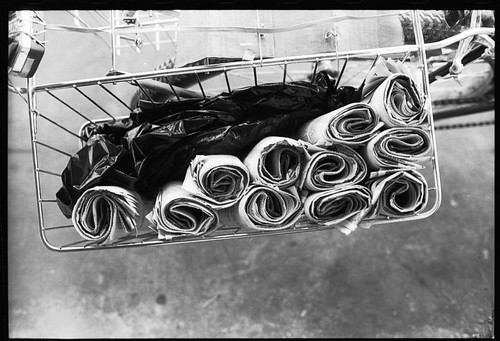
The paper bundle gets thrown out of the station wagon at just before six a.m. This was in the days when afternoon papers still existed. His grandparents subscribed to the morning paper and another in the afternoon. You read the morning paper before work over coffee and on the bus. The afternoon paper you read when you got home, maybe before dinner or after dessert. But on weekends, the afternoon paper - delivered after school on weekdays - arrives in a bundle at the paperboy’s house at six a.m. for morning delivery.
Hard now to imagine a world in which ordinary people read this much. Hard to imagine ordinary people expecting their weekend paper to arrive at seven a.m. so they could begin their busy weekend morning nearly before the sun. Did TV replace that, he wonders? All that reading? All that activity that was neither work, nor commerce? He remembers his own grandpa, building, building, ever hammering, painting, fixing. And cards at night with friends, his Honey and grandpa. And sure some TV then too, mostly “Bowling for Dollars” and national news. Hard now to imagine what other people’s grandparents were doing after they drank their coffee and read the paper at eight a.m. on a Saturday morning.
The paper bundle hits the sidewalk maybe a little early at five-thirty and what a boy about ten or so should be doing at that time of the morning: sleeping. The alarm goes off at 6am and he promptly turns it off and goes back to sleep. Just for a few minutes, please.
What drove his step-dad, he wonders, to take it upon himself to worry about the boy and his paper route, whether he was late or on-time, whether he appeared responsible or irresponsible? Such a mysterious other world view. A compulsion to instill certain values in our children, by hook or by crook. A fundamental misunderstanding about the nature of human nature and what motivates people. A generation of Dr. Spock behaviorists at war with all things natural.
At six-fifteen, dad wakes him up. Shaking the bed or his foot. “Get up,” he says, “Your papers are here.”
He stops for a moment digging. Rests his hands against the shovel. Looks at one hand and then the other. Not course and rough, like his grandpa's hands. But still, they have their scars and rough spots. Evidence of a life spent working in one way or another. "Honey?" a call from the house, a face looking out a window. He waves and smiles and gets a oh-there-you-are look, a smile in return.
A battle of wills, he guesses, is how step-dad must have seen it. He imagines him now, awakened by the slap of the bundle on the driveway. Lying in bed, wakeful, listening. The alarm goes off from the next room. Listening for feet hitting the floor, drawers opening, floorboards squeaking, a door. Hearing none of this, a familiar anger rising. A sense of frustration mixed with a hint of pleasure, like a tooth ache, a feeling of place and role and irresolute duty and knowing that every knock left or right puts the boy a little more in line. And dad knows, God, how he knows, from his own kids how little it takes for boys to get far off-course. Willpower and discipline and firm rules, all that separate kids from a tumble into the wrong path.
The next visit at six-thirty is less subtle, “Get up” and the covers come off. A little boy in PJs suddenly cold, suddenly awake, looking up startled, frightened, but with the merest trace of the defiant righteousness of someone who knows he is being bullied. Something he knows he’s carried right into adulthood.
“Okay, okay,” he says. “I’m getting up.” Step-dad waits silently, and the boy has to turn this concession into action and swing his feet to the floor before he leaves silently.
Six-thirty a.m. Nine months of the year, it’s still dark out. The boy rubs his eyes, tests his shaky legs. There’s a false promise on the air -- he thinks this every Saturday and Sunday morning -- that if he hurries through his route, he can go back to bed. It’s never happened and probably won’t. Because when he gets out on his bike early on a weekend morning out in the cool air, a whole free day ahead of him, the world is his oyster.
He remembers his ex-wife saying once as they were in the homestretch to a meltdown, "I don't know why you have all these projects, you never finish anything." A comment said with such ferocity and disgust that it made him uncertain for years. Now he looks back and sees such a stretch of things accomplished, ideas hatched, plans made, projects finished, that it makes him feel humble. A complicated proud and humble feeling. On good days, a feeling that he is merely a vessel of energy of which he has responsibility. Still, he thinks of this moment with his just-about-to-be ex-wife every time he finishes something. And here again, he wonders about Heisenberg.
But, oh, so many steps to go before he can ride. Put on warm clothes. Open the garage. Unbundle the papers with a little explosion as the plastic ribbon tie is released. Slide in any inserts. Saturday morning: no inserts. Sunday morning: more inserts than the rest of the week combined (excepting maybe Wednesday). The only consolation for this extra trouble, reading the Sunday funnies while he folds. Folding the papers. Saturday, the slim paper gets folded vertically into thirds. Sunday, it’s too big for this. The Sunday paper is folded once over horizontally, that is, folded in half parallel with the paper’s masthead. There’s a right way to do this, he thinks. The paper should be folded so the masthead itself is still visible. This has nothing to do with his feelings about the newspaper. It’s his own funny way of things. If you explain something to him, show him how to do something, and it seems to fit, you’ll never have to show him again. If your way is not quite right, the long way, wasteful of energy, unclear of reasons, awkward, there really isn’t much you can do short of a thrashing that can get this boy to do it your way. And he’ll say he forgot, and that isn’t completely untrue. He’s not willful quite, just something else. He knows he’s carried this trait right through to adulthood too.
The papers go in the bag, and the bag gets wrapped around the handlebars just so. The bags, the papers, the rubber bands, the inserts, the bike, these are tools of a sort of trade. All so familiar, like his left arm or pinky toe. He’s sure, even now, he could easily get on a bike. The weight of the paper, the subtle flick of the wrist could put a paper right next to someone’s door from ten yards away, these years later.
And closing the garage door and closing the gate, he’s off on his bike, sometimes with his dog chasing off in front, sometimes no, riding into adulthood with all its insecurity and independence.