

You're sitting on the front steps of the little two bedroom place that you and your new bride rent -- your charming little cottage with the big picture window and the hardwood floors recently refinished -- and the baby is expected but not arrived yet, so she still pays attention to you, especially today that the warm sun is coming through the lemon tree and warming the cement and there is somehow, miraculously, nothing to do.
You lean to the left and there is warm sun, almost hot, openness, and laughter. You lean to the right and there is cool shade and secrets not yet revealed. Hot and cold. Yin and yang. And together they form perfection. What could possibly improve all this?
What if in this scene, the two people previously pictured, you and the woman of swollen belly, your lover and wife, were sitting in the falling sunshine with glasses of cold lemonade in your hands and the tinkling of ice cubes in your ears?
So you get up and wrestle the ladder that leans against the house. You climb precariously to the loveliest lemons near the top of the tree standing on the sticker that says, "This is not a step." You pick three lemons and realize you have no way to gather more, nowhere to put them, and of course, the ivy at the foot of the tree swallows anything dropped without a trace. So you tuck in your shirt doing a funny dance at the top of the ladder, your audience laughing from down below. You drop the lemons down your shirt and continue picking, looking increasingly comic as the lemons make you look pregnant too.
You climb down and disappear into the house, the cool house. Chop, chop, chop. Cut each lemon in half with the Chinese clever. Work each lemon over the glass juicer you found on the Saturday garage sale outings until your right arm hurts, then switch to your left. Fill up a bowl, and get another. Juice every last lemon until you have a few quarts of juice. Taste it with a finger. Oooo, sour.
Don't forget to strain the seeds through the cheesecloth you keep in the drawer on the end.
You put a few cups of water on the stove to boil and sit down at the kitchen table to wait. The cool dark of the house sucks at the warm brightness just outside the door.
You look around this kitchen that you and she put together from the total of both your stuff. Your knife, your wok, your cookware. All the pink plasticware that her mom gave her little girl when she moved into her very own place. And you remember again that you are criticized for thinking in terms of yours and mine. "Its all our stuff now," your wife says.
When the water boils, you drop in several cups of sugar, enjoying how it puts its fingers to its lips and shushes you as you pour. Dissolve the sugar and add this solution to the lemon juice.
You pinch in just a tiny bit of salt. Yes, its true, your wife thinks that's weird, but you know it makes perfect lemonade taste even better.
Adjust the amount of sugar in this concentrate. You want the sweet and the sour to achieve a perfect balance. Yin and yang again. Put this mix in the big juice pitcher.
Now if you weren't wanting to go back out on the steps right now, you'd put the mix in the fridge until it cooled. But you can chill that warm concentrate with ice. Fill up a couple big glasses with ice cubes and pour the warm concentrate over. Not too much now, you can always add more if it's too weak.
Add just enough ice water from the fridge. After a little bit, you'll get the hang of "just enough."
Don't forget to re-fill the ice trays. You usually remember, even though your lover usually forgets. There are unresolved issues of protocol here. Each one of you has his or her definitions of considerate. You're slowly re-learning what's right and what's important, according to her.
You grab a box of crackers and balance the two glasses and step blindly out into the sunshine. "Here, Honey," you say as you hand one glass over with a bow. She reaches up, mumbles a half-hearted thanks and continues reading.
There is a moment of waiting. Did you expect applause? By now, you realize the little kindnesses are seldom recognized. But is it worth making a bit deal about right now?
You make your way to the porch swing on the other side of the house, not quite as idyllic, full shade rather than dappled sunshine. But you have a glass of lemonade and the ice talks gently against the side of the glass. And you're alone and its okay and the journey matters more than the destination anyway.

I'd like to live in a house on the water, a homemade houseboat, with a small engine that can move it slowly from here to there. A water squatter. A place with tin roof and tin walls, insulated for winter, with a wood burning stove for heating and cooking. A porch, a porch swing, a lookout, windows, a banjo on the wall. Wood piled up in a wood pile on shore. A bucket shitter behind a curtain. Big and wide for a boat, difficult to capsize, made of scrap and scavenged things. Feathers from a hawk, phtographs from a garage sale, letters from home. A big wide bed with a dense down comforter and a homemade quilt.

| Letter to my dad, but not my father figure. | |
| To my friend, who happens to be my son. | |
| Dear Son, | Dear Dad, |
| There’s a moment in your childhood that I still have both the photograph and the photographic memory of. You were standing beside a chain link fence near Tehachapi looking at me, humoring me and my photography, with your curly blond hair and beautiful brown eyes. How old were you? Maybe seven. Maybe eight. We were on a rare camping trip alone. Rare, not because I didn’t want to spend every minute with you, but because… well, because… really, this is where story breaks down. | |
| I am awake and heading into town. You were right about writing early. Beautiful thoughts are filling my head this morning, giving me sway to write (now I am not so sure they are beautiful, but it feels good to have them in my head). It would be nice to see you, even if just for a moment. The coffee will be extra strong if you agree to come see me. | |
| (he agreed) | (he agreed) |
| In retrospect, we fold under the raw parts and comb up the nap on the handsome memorable parts. We mellow with age and our stories get dull and dishonest. We establish detente with those we fought tooth and nail. | |
| A drip of water drops next to me this morning. I am outside, and there are no lampposts, overhangs, or trees near me, so I can’t understand where it came from. Maybe just a lone raindrop? That seems unlikely. I am completely stumped over this single drip, so I look up. | |
| A true life of insurgency - of constant social conflict - is hard to maintain. And the youth, with their bitter urgency, know this all too well. Someday, they too will find themselves on the other end of a phone call with an old hated enemy sharing the worried fate of someone they both love. | |
| Powerlines | |
| Of course. | Of course. There are powerlines constantly over my head- so often in fact, that their presence has ceased to register on my mental radar screen. This morning a drip of water drops from some powerlines, wet after a heavy rain the previous night, whizzes right past my face, and for the life of me I can’t figure it out. If I was focusing on the powerlines, hanging dangerous and flaccid above me, all the time, would I start to go insane? |
| I never felt the role of a parent is to keep you out of danger, to constantly parcel and to measure and to weigh and to judge and to allow and to disallow and to set on the straight and narrow. It exhausted me then and exhausts me to even think of that now. | Watsonville and Santa Cruz do not exist on a map. They are not related to each other by any miles or compass directions. They only exist as two ends of a lonely busline that I take every day. An hour there, and an hour back. |
| Do not say that I am not a morning person. I hate that. You say “geez, you’re not much of a morning person, are you?” | |
| You’re not much of a morning person, are you? | |
| And I will say, “Just because I don’t enjoy blithely socializing with everyone I know the moment I wake up doesn’t mean I’m not a morning person. I love the morning, but I prefer to spend it differently than you do.” | |
| I felt that, especially in your sometimes surly, sometimes contentious, sometimes inexplicably angry adolescence that one of the best things I could do for you is to stay the fuck out of your way. But it starts well before this. | |
| I came up with that before anyone had said anything so that when someone did I would seem quick-witted, opinionated, and ready and maybe for that moment I would transform into a comic book character. | |
| Of course, there were times when I sensed you just wanted me to be with you, to be present, to listen. I could have, and I didn’t. | |
| Dad, | |
| It starts earlier, the time of climbing trees, camping in the desert, walks in the woods. An opening up, our lives interwoven like fingers holding hands. It was around then, that you were taken away. And even when things got better, when things got more then better, when they turned around completely, there was something in me that was never quite fixed. | |
| you told me that when you were a kid you spent a lot of your time coming up with good comebacks. Comebacks that would penetrate your bully’s deepest insecurities- something that would cut to the quick (a phrase I’ve always enjoyed). | |
| The sharp edges of words, of the tossed barb, the cutting comment that can lodge and fester. | |
| Something so devastatingly true that it would cut the conversation clean off. The jack of trump of all 5th grade squabbles. Is that really what you wanted, dad? | |
| I lived with a woman once who could kick my virtues, one by one, out from under me, leaving me contemplating the rope or the car? The poison or the sea? | |
| Is that really what I want? To be the best undiscovered retort writer in school, brooding in secret corners, spilling over with brilliant quips to which their conversational counterparts will remain only imaginary? | |
| I caved in my heart to conform. It left a solid little dented thing. I haven’t looked people in the eyes quite the same since. | Or is the goal really just the private satisfaction gained from playing these idyllic scenarios out, over and over in our heads, being convinced that for them to actually take place would be contrived and unnecessary so that we can do our best to refrain from steering every casual conversation to that impossible desired setup? |
| The cutting word. | The cutting word. |
| I always wanted, you point out, to be master of these weapons. But | |
| Honestly | Honestly |
| I didn’t have the heart or the inclination. I never wanted to hurt anyone enough to use the clever, stored-up, devastating truth that cuts to the bone. | |
| Even if I had it. | Even if I had it. |
| Dani and I talked about teams the other day. You know the kind. Your special, secret, private team of people you know, for the hard times, for the good times, for when the shit finally and climactically goes down. | |
| I feel that rage in you sometimes and it scares the hell out of me. Not in the usual way that parents are scared for their kids. But for me. | Everybody has a list in their head or on paper of at least the first few people, if they don’t already have the whole list pegged. |
| If you didn’t think about this before, you’re going to now. | |
| When we break a window in a fight, or bust a door, I want to get into my bed and pull the covers over my head and come out in approximately 4 to 5 years when it’s all over. | |
| We talked fondly of our teams, naming names. I admitted that my team’s first slot was private, but that I had a terrible feeling that even though the person was at the top of the list, they would evasively never be on my team. | |
| I want to turn in my fancy bronze parenting star and trade it in for a little modest friend patch that I can sew on to my favorite shirt, | |
| the one I wear only when I’m feeling strong and worthy enough. | Dani told me that she had the first three people (at least!) solidly down, and |
| I was under the impression that they had even all talked about and agreed on this. | |
| We camped in a gully and cooked and ate pasta and slept in the car. It was one of my best memories from your childhood. It was one of your best memories. It was perfect, or retrospect paints it so. And that’s the way we tell those stories. Maybe we can do that again sometime. Or we said that, or we always wanted to. | It’s chilly today, but not a deep chill. Chilly like it’s supposed be chilly- chilly breezes, but everything’s dry and the sun’s warming me a little. I had a smell in my nose a couple of minutes ago like chicago or a smell like waiting in a trainyard. It didn’t smell like chigaco or the trainyard, but like the experience of it. It smelled good. Really good. I think I am smart enough in my life now to understand what that means. |
| Of course everyone has a dad story, and a mom story, and we tell these stories and everyone understands. Some are heartwarming and some help explain where we came from. | |
| Dad, this is not a nostalgic letter- don’t get confused now. | |
| Nostalgia, I guess. But the stories we tell about our children have to fit a certain mold. We, the grown-ups, are forbidden to tell stories about suffering, and the stories that we are left with are all so boring we forget them as soon as they are told. | |
| But when you hug me, you pull on the hair on the back of my head, just above my neck, so hard that it hurts and I know that you love me. | |
| And after a while, they’re no longer heard, and we no longer tell them anyway because our hearts were never in it to begin with. | |
| This is not a love letter either, but when you write to me you say “I love you so much, I can’t even tell you,” you of course, keep to your word on that. | |
| If truth be told, you were homesick and mad at me on that trip. I fought your mom for weeks to take you and she almost made me cancel. | |
| Sometimes we only tell the whole truth, when we cry alone. But I need you to know, that in spite of everything, when I secretly devise my team, you’re on it. | Dad, this letter is for you, but for fuck’s sake, don’t read it, because neither of us wants you to know that when I secretly devise my team, you’re my number one. |
| I have your back, come hell or high water, come whatever. Your anger and frustration, the way you spit “You kept your word,” notwithstanding, I hope you know that. | |
| You were always on my secret team, and yes, I’d thought of that before, | |
| even when you didn’t think so, even when I was stupidly hopeful, even when you were an eight-year old kid believing the lies of a jealous parent. | But you kept your word, and since you love me, you damn sure ain’t tellin’. And if you love me, I sure as hell will be the last to know, |
| so when you come in for your coffee, you better expect it to be cold because you took too long to get here and I got tired of waiting and went back on home. | |
| I hope it’s not too late to tell you that I love you. My number one slot is open for you when you want it, | |
| This time, my busline is some other number. | |
| but not until then. | |
| An hour there, and an hour, and an hour, and- | |

You have been tagged in this note. Now you are obligated by the law of chain letters to respond. I was going to tell you about this guy in Peoria who didn't pass this on, but I won't tell you about his tragic misfortune.
Here are the Rules: Once you've been tagged, you are supposed to write a note with 25 random things, facts, habits, or goals about you. At the end, choose 25 people to be tagged. You have to tag the person who tagged you. You have to. If I tagged you, it's because I want to know more about you. Really, I do.
- I was born in Inglewood, in the heart of the ghetto, but so many years ago, its ghetto future was still on the horizon as the last of the old white World War 2 generation was slowly creeping into their final years. There was an apricot tree in our front yard in which I spent days at a time high in the branches.
- The rest of my time I spent reading. I’ve had the same three favorite books -- past Conrad and Tolkien, Salinger and Morrison, Bowles and Borges, Rushdie and Delillo, Orwell, Vonnegut, Faulkner -- the same three books at the top of my list since they were introduced to me in 5th grade.
- Looking back, I am pretty sure that all my best friends from earliest grammar school onward have been gay. But as a young sheltered lower-middle class white kid, I genuinely didn’t think gay was something ordinary people could be -- only a derisive name made up by kids. I was an overly-friendly mamma's boy with oddball social skills, and inevitably other kids incorrectly concluded I was gay too.
- I was gay.
- Well, not really. Sort of. Let me explain. I liked some boys, but I mostly liked girls. Even if I lost my virginity to a boy. In church. But they tell me that doesn't count -- everyone has their early experimentation -- this is not a score in the race to deflowering.
- I am an anarchist, which means I think I know better than governments, better than corporations, better than institutions, better than you, better than anyone what is best for my life. I believe that our communities know best what’s good for them too. On a practical level, I don't believe in police and jails and military force. I don't believe in your laws and representatives and electoral politics. I already cast my vote in the street.
- I got your back.
- I'm an anarchist, but not that kind of anarchist. I am less bigoted than anybody I know. This may be the result of early and extensive product testing of Sesame Street on my young mind.
- When I first heard Indonesian gamelan, it was like a musical orgasm. I thought, “Oh, of course. There it is.” It immediately felt right, like the music of the spheres, or the sounds made by the turning of the gears of the Universe, divine, particulate and yet inseparable. It was the music I’d always longed to hear, the music I heard hints of in every beautiful chord, in every inspired melody, in every inexplicable, untouchable rhythm all my life.
- When I was twelve, I used to tell my parents I was going to visit a friend, and then secretly ride my ten speed across LA to the ocean and spend the day bobbing in the warm waters of the Pacific Ocean. I have secret lives, thousands of secrets I’ve never told anyone. I’m not sure how this is, since I feel like all I do is tell stories constantly.
- I tell stories constantly. I believe in stories. I believe human beings traffic in stories. We ooze them out of our pores, exude them around us. Let me tell you about my day, or my life, or something that happened to me once upon a time.
- I’ve been accosted numerous times by people who thought I was a long-lost friend. Each time it leaves me off-balance and wondering if I am leading a secret life, part of a witness protection program that I’ve forced myself to forget. One time a motorcycle repairman in Visalia named Marlon was sure I was his long-disappeared brother, and quizzed me skeptically about the details of my life. This is not just a story.
- I often feel that there is something that. we're. just. not. reaching. I want to touch that thing that moves just below the surface, just beneath our perspectives and symbols and abstractions and bullshit and hang-ups and distractions. I want to get to that impossible, anything-but-comfortable, just-beyond-the-edges frightening place. Where is that? All my life, literature comes closest to touching it.
- Those three favorite books are the Phantom Tollbooth, Kon Tiki, and Never Cry Wolf. The 5th grade librarian of Harbor City Elementary should be held responsible for disemboweling the brain of an eleven year old and filling it with adventure rage humor desire and whimsy. Thor Heyerdahl fucked with my life. Someday I will spend months at sea, a blue dome of solitude from horizon to horizon, on a raft at the mercy of wind and sea. I’ve longed deeply for this everyday of my life for the last thirty years..
- My only regret is that life is so short and there are so many things I’d like to devote my full attention to, that I will probably never be a midwife or a sailor or a writer or an outlaw or a terrorist or a full-time vagabond or a thousand other things.
- As it is, I am a jack-of-all-trades, master of none. But I once made a list, an inventory as it were, of all the things I could do competently. It exceeded four pages small print, and included build a house, perform CPR, identify wild plants, program any computer language you can give me, complete a triathlon, hop trains, acquire almost anything for close to free, bake bread, build a homemade raft, make radio, make love, make wine, make a bomb, and weld.
- All my life I’ve considered myself a poor dancer. Scared, shy, self-conscious, awkward, all things that do nothing to contribute to dancing well. Years ago, a friend invited me to contra dance, something like squaredancing, where I discovered to my surprise that I am an excellent dancer. A dance like the wind, me, my partner, turning like a top, with precision, with procession, faster and faster. The middle-aged ladies vie for an opportunity to dance with me.
- I have to be honest with you. I don’t really think of myself as gay. But I believe sexuality is a spectrum. I ask you. Who is completely straight or completely bent? Who doesn’t fall in the middle somewhere? While shyly, I consider myself queer, I haven’t fallen in love with a boy in a long time. Though I was thinking recently, why not? The boys I know are unbelievably dreamy. But I think in my boy-boy fumblings, that I’d be too scared to initiate one goddamn thing.
- I stole this, but its still true: I am a secret bottom, waiting for a worthy top.
- I don’t eat the critters. Floating on the Missouri River on a raft made of trash, my fishing attempts were rewarded by two large catfish. I realized in that instant that I had never killed and cleaned a fish. Never killed an animal. Not personally. Not with my own hands. Looking into the eyes of my captives, ending their life with a knife, and taking their energy for my own was an experience sublime. From that moment, I didn’t want to eat anyone with whom I didn’t share that connection. A conversion to vegetarianism that took me completely by surprise. By that same token, I don’t hurt the peoples, who after all are just critters.
- However, I can see the necessity of a bullet in the head of the slavemaster. Meant with all the love and compassion I can muster. A recognition that every animal has a context and a nature and acts out that destiny according to its programming. And perhaps my oppressor is only an animal trained to dominate. But perhaps I am an animal that has learned to resist. Nothing personal, you understand. I will mourn your passing this world and, at the same time, celebrate the possibility this creates.
- I often hear poets claim words are a weapon. But I don’t see words being used to stab, punch, pry, and destroy. If you were wielding words like battle axes, you wouldn’t have to tell me. I want to see Shiva in everything we create. A frenzy of creation and destruction. Tear down what we build, and build up what we tear down. The inexorable need to stomp the sandcastle we painstakingly build. And then build it anew. Or better yet, just let the ocean take it back.
- I want art so dangerous that merely creating it may cut us. I want art so dangerous it creates irrational, instinctive, intuitive panic in the hearts of authoritarians. Art that doesn’t talk about revolution, but art that spawns revolutions. Not merely challenges, but rips down the status quo. I don’t want revolutionary artists, or artistic revolutionaries — I want to abolish both words, smudge the lines until they are one and the same.
- I’m no longer an apocalypse fetishist, a radical that hangs on to the idea of a post-rev paradise. I see revolutionaries that remind me of the Seventh Day Adventists of my youth, with tracts of a similar flavor: Awake! Alert! Alarm! ATR wishes and plans and schemes. Dreams of life that only begins in a post-collapse world where the lion will lay down with the lamb. But from what I see, the cataclysm means the rich get richer and the poor and the black an the brown and the crazy an the very old and the very young get fucked. And too often the revolution is bloodier and more brutal than what it replaces.
- But still. But still. But still I crave disaster because it opens up possibilities. The usual rules are off. The established relationships no longer apply. A chance to breath, a chance to stretch our arms and fly. I want everyday to be a revolution. I want to practice disaster in every moment.

One winter morning, I had crab in Bandon, Oregon.
I went up the coast and went out one morning and bought crab in Bandon, Oregon.
I drove up along the rugged coast of Oregon and went out one morning and got crab in Bandon, Oregon.
I rode up the coast on my motorcycle just as my marriage was ending and stayed at a hostel. I was lonely and so I woke before dawn one morning and walked out to the docks and talked to the fishermen. I bought a crab and went back to the hostel and cooked it and ate it for breakfast in Bandon, Oregon.
I rode up the coast of Oregon looking for solitude and some measure of inner peace, and stayed in a youth hostel right along the beach. I read the Tao Te Ching and meditated in the cool morning air before walking down to the beach and watching the early fishermen catching crabs in pots that they lowered from the dock. I bought and cooked a brilliant pink King Crab nearly eight inches across and ate it before getting ready to go back south in Bandon, Oregon.
I rode into town looking for something, not knowing what it was, but found it in a funny, unexpected way one morning when I rose early and watched the seagulls and the fishermen fishing off the docks, and bought a big crab and ate it sitting outside on a wall in the cold air burning my fingers on the bright pink shell and letting the soft white flesh melt in my mouth in Bandon, Oregon.
And that was in Bandon, Oregon, where I stopped on a roadtrip one morning, partly just because I liked the sound of the name at a moment when its coded meanings and infinite possibilities spoke to me most.
I've collected stamps, glass insulators, road reflectors, old lanterns, furniture, license plates, books, turn of the century cooking utensils, Schwinn Stingrays, marbles, comic books, Hot Wheels, and Star Wars action figures. I've flirted with a thousand different collections. Sewing machines, 50's cars, lawn ornaments. I've collected millions of individual items. The fads have come and gone, but through it all, I've collected records.
I have over ten thousand records in my collection now, in three storage lockers. I estimate I've spent nearly a 100 thousand dollars over a lifetime of record collecting.
Here are the top 5 most valuable records in history:
- John Lennon & Yoko Ono – Double Fantasy (1980) – $525,000 – Autographed by Lennon five hours before Mark David Chapman assassinated him.
- The Quarrymen – “That’ll Be the Day”/”In Spite Of All The Danger” (1958) – $180,000 – Only one copy made.
- The Beatles – Yesterday and Today (1966) -- $85,000 – with rare cover of Beatles in butcher smocks, covered in baby parts and raw meat
- Bob Dylan – The Freewheelin’ Bob Dylan (1963) – $35,000 – Featuring 4 tracks deleted from subsequent releases.
- Long Cleve Reed & Little Harvey Hull – “Original Stack O’Lee Blues” (1927) –$30,000 – 78 RPM in plain sleeve.
My collection isn't worth near that, but any day one of the gems of my collection may reach maturity and make me a million. That is, if I could bear to sell it. I was once offered four thousand dollars for the pride of my collection: A very rare 1930 recording of Duke Ellington.
My crowning achievement as a collector was so easy it was almost criminal. My Great Aunt Ethel lived in Portland, Oregon. I joined my grandparents on what we thought might be our last visit before her death. Whenever I go over to an old person's house, I thumb through their music collection. Just in case. You never know what you might find. And this visit to Aunt Ethel paid off. I found a collection of 78s in a box beside an old Victrola in an upstairs room. It was her sewing room. She hadn't sewed in twenty years since the arthritis. The room was thick with dust. The box of records was underneath piles and piles of scrap cloth and half finished quilts.
I found the box by the Victrola, and my heart raced. I always begin to sweat with anticipation when I know I've found undiscovered treasure. An entire box of old 78s. I thumbed through the records one by one. Most of the records were commonplace in the collector's market and were nearly worthless. Furthermore, most had been played out or scratched beyond repair.
But, near the back, there was a box set. It was a Duke Ellington collection. This was a very old set of records. Each of the records except one were marked with deep scratches. Daggers pierced my heart as I slid each one out of its sleeve and saw its condition. My life's find seemed to be slipping away. But the last record was in a sealed envelope of translucent cellophane. I could read the label. It was a Victor recording of Duke Ellington and his Orchestra. Ring Dem Bells was on the A-side. Mood Indigo was the B-side. It looked like it had never been played! It was the find of the century!
I cradled the entire set in my arms as I descended the stairs. I panicked when I began to wonder if the old bat would give me the record. Would I have to buy it from her? Mightn't she guess its great value if I was willing to buy such an old record? I decided to try to keep it casual. I had to stop and calm down. I sat at the bottom of the stairs with the Duke and breathed deep breaths.
"Hi, Aunty," I said to the old woman in her wheelchair.
"What you been up to, boy? Mischief?" she asked.
"I was admiring all your great old stuff upstairs," I positioned.
"What great old stuff?" she asked suspiciously.
"The old furniture, the grandfather clock in the hall," I said casually.
"Are you waiting for me to die, Son?" she squinted at me.
"All those memories," I said trying to work my way around to my casual question. "You use all that stuff? The sewing machine? The old Victrola?"
"No, I don't use it anymore, boy. The arthritis keeps me from sewing, you know. And why would I want to use the old Victrola? I have me a cassette deck radio right here that I don't have to keep winding," she smiled and patted the cassette radio my dad had bought her.
"I love that old Victrola. It puts me in touch with another era," I dropped.
"Hmmm," she muttered, lost in another era herself.
"Is there any way I could borrow it?" I asked.
"The Victrola? Sure. Take it away. And any other trash you find up in that sewing room."
"Can I have the records that go with it?" I asked, almost beside myself with excitement.
Suddenly she got very grave. "No," she said sternly. "Those were Bob's records. You can borrow them if you like, but you can't have them."
"Aunty, can I ask you a question? I was curious about this record," I said, holding up my treasure. She extended her hands and I got fearful to turn it over to the old woman. I reluctantly gave it to her and sent up a little prayer that she wouldn't open it.
She looked at it a moment and made a frowny face. "Do you know the record, Aunty?" I said.
"Yes," she said. "Bobby listened to those Negro composers, the Jazz men, back then."
I gently snatched the record back as her focus shifted inward. "But it's never been opened," I said. "How come?"
"Well, that came in that box of records, right?" she was sharp as tacks. "That song on that record was playing everywhere you went. You went to a party or a dance and it was playing. You went to a store and someone had it on the record player. You couldn't get away from it. And so I told Bobby that if I ever heard it played on our Victrola, I would pick it up and break it. So it was never even taken out of the paper."
I took the record home, almost forgetting to take the Victrola as well. And I lived in fear for the next several years that Aunt Ethel would ask for it back. When she called I felt awash with guilt. When my parents or grandparents went to visit, I found an excuse not to go. I didn't know if she remembered my loan, but I took no chances. She finally died and I heaved a sigh of relief. The record was mine.
I kept it in the envelope, unopened, in mint condition. It's the pride of my collection.
That record, that wax testimony to the genius of Duke Ellington, has been heard only one time. It was broken out of its cellophane envelope, and the mystery that was a sixty year-old never-played 78rpm recording of a rare studio session dissolved in seven minutes. The record itself dropped several hundred dollars in value that day, I thought.
I dated a woman named Jacqueline well after college. We were to be married. She was a collector too. We would spend summer weekends driving around to garage sales looking for the Big Find. Once a month we would go all day Saturday to the City to several of the big auctions. We were going to open an antique and collectibles shop together.
The shop was going to sell "antique" furniture and knickknacks to the old women who come here as tourists. The stuff would be old, but none of it antique. It would be a place where we could get rid of all of the stuff that we no longer wanted to collect. Or stuff that had fallen so far in value that it was no longer worth storing. The general public has no good sense when it comes to old things. People would rather buy a beat up old dresser than a perfectly preserved one decades older. The reason, you see, is because it looks older. And what good is it, they figure, to spend the money on antiques if they don't look their age? Don't even talk to me about "distressed" furniture. Makes me a little sick.
Jacqueline and I were fiends. She was a master bargainer. She could talk the tusks off an elephant. Also, she was a great salesman. She could sell water to a fish. With her as my partner, I couldn't loose in the business. We'd secured loans from our parents and several friends and were hoping to set ourselves up in business the following year.
We were great in business and great in bed. We made love in an 19th century King Louis bed in a dark recess of a museum in Amsterdam. We collected King Louis furniture for the next six months and refurnished our bedroom. We would both meet in period costume in the garden. We would greet cordially and talk pleasantly. Then when we were both flushed and breathing hard with anticipation, I would grab her, take her back to our bedroom and ravish her.
But Jacqueline was a jealous lover. She was competitive as well. Though we bought many items for our collection with our combined money, we both collected and kept things that we understood were part of our private stashes. Whenever I found a new treasure, Jacqueline had to best me with a find for one of her collections. If I found a rare old record, Jacqueline had to find a rare porcelain doll. If I found a like-new Schwinn Stingray, Jacqueline would look for a Fiestaware place setting in radioactive red.
She was crazy about my record collection. I'd started the collection fifteen years before I met her, and I didn't see any reason why I should share it. It was mine. I wanted to keep something for myself, something that was just mine and no one else's. Is that so wrong?
When we first met, she bought me several records for the collection. Her first attempts were lame because she didn't know the field. But after a while she got better at sizing up a valuable recording, and before we were living together, would often bring me fantastic finds from hours of combing used record stores. She started collecting records of interest to her, old 70s albums that could be found by the dozen in thrift stores, but would be rare in another twenty years. We were courting and collecting together.
First she asked me to share my collection. Sometime after we moved in together, she referred to the records as "our collection." I gently, but firmly told her it was mine. I don't regret keeping it to myself, but probably the seeds were planted in that moment for the beginning of the end.
Later, she asked me to sell the collection to fund our business. Then when I refused, she got angry and accused me of loving my records more than her. It was the worst argument of our romance.
"How could you even ask me to sell the collection?" I screamed. "Its always brought me so much joy," I said.
"If you are so happy with it, why don't you marry it?" she yelled.
We patched up the fight and made things right again. But there was always a glimmer of accusation and distrust around the subject of my records. We tacitly agreed never to talk about it. I no longer told her when I'd made a great find. I no longer joyously played old records for her. I had a very brief affair with a new record collector upstate. But Jacqueline and I had other fish to fry and we moved on, planning the business and acquiring salable items.
One day I home and surprised Jacqueline in the bedroom. She looked up guiltily and little bit defiant. She was holding my Duke Ellington record. I stood there a little stunned, wondering what she was planning to do. It was kept in a special case inside a fireproof filing cabinet in our bedroom. The record had still never been played. It was sealed in its cellophane envelope like the day it had left the Victor factory.
"You've never listened to this thing," Jacqueline said, looking up at me.
"No. It's never been played," I said. "It's very rare. Over seventy years-old now."
"Never? Why not?" she asked.
I told her the story Aunt Ethel had told me, though I knew I must have told her before.
"And you've never gotten curious?" she asked.
"Oh sure," I said, "But I know its worth so much more--"
"Yeah, yeah," she said cutting me off. "I know about your offer. Three thousand dollars, but you wouldn't sell."
"Four," I said.
"Four thousand," she said. "Wanna put it on now? Wanna hear it? We could make love while Duke Ellington plays for us, straight out of the past." I'd found that Aunt Ethel's old Victrola was actually worth something
after all, and it sat on an antique table in the bedroom. Jacqueline started to walk over to it.
"No!" I shouted.
She stopped and looked alarmed. "I was kidding. Kidding." She shook her head. "Geez, Louise," she said and carelessly tossed Duke Ellington to me and strutted out of the room. I hated her for that one moment. And then it passed.
Three months later. We were weeks away from opening the business. The location was secured. We had a deposit down on the lease. We had crews lined up to renovate the place and move the fixtures and antiques into the shop on the first of the month. The pressure was enormous. We were getting no sleep. We hadn't made love in weeks, months maybe. We didn't argue, but we didn't talk either. We grunted orders at each other.
"Uh, get the door."
"Hmmm, grab some burgers while you're out."
"Hey, don't forget the tax forms."
"Pick up that chair you bought last weekend."
Jacqueline had gone home early to throw together some dinner before we had to go back down to the shop and work the rest of the evening. I was going to stay assembling fixtures until she called me for dinner.
I gouged my thumb with a screwdriver and found that we didn't have any Band-Aids down at the shop. I was getting hungry and decided it was time to pack up for now.
When I opened the door, my heart sank into the pit of my stomach. I heard the first few piano bars of Mood Indigo. I knew. Immediately. I ran, though it was already too late. When I reached the bedroom door, the clarinet began its sad solo. I stood with my mouth open and looked at Jacqueline. She was standing over my Aunt Ethel's old Victrola staring down at Duke Ellington spinning on the turntable. She was smiling. I was in shock. I wondered what she was smiling at.
Then I began to hear the music.
It was so finely textured I couldn't tell where one sound started and another began. It was a synthetic whole. It was one piece of finely woven cloth with clever variations of texture and mood. It was lonely and exultant. Somehow happy and sad. I saw in it reflected the entire Black experience in America, the hope and the heartbreak.
The quality was like a punch in the ears. A never before played 78rpm recording of a musical genius with almost no hiss. It was like a voice across the years. The trombone tripped up and down the scales, rising to meet the clarinet which took the lead. With the bass clarinet providing undertones, the clarinet made impossibly complex rich music. Then the whole orchestration fell into a more somber groove, with now-and-then flashes of improvisation from the clarinet. I'd heard the words to the song in later recordings and couldn't help hearing them now in my head.
You ain't been blue... no, no, no...
You ain't been blue, till you had that mood indigo...
Then as the clarinet and trombone took it home slow and sad, Duke finished with a flare, those staccato blasts from those great horns! Chills ran up and down my spine. Jacqueline was still staring at the record, smiling.
The record ended with the distinctive hiss-hiss-hiss-hiss-hiss of the 78. I was still anchored to my spot. My mouth was still open. My record was still going around and around and around.
Jacqueline looked up, and we looked at each other's soul for the last time.
-o-
Prologue
She left the next day. I wanted her to leave and so did she.
I found out later in correspondence with one of the most esteemed vintage record collector in the country, that being in the factory packaging seldom affects the price of a high-end vintage record sale. They look exclusively at its rarity and its condition, he said. The experts would have had to take it out of its wrapper to grade it anyway.
I'm hopping to open up a shop here sometime soon. I don't have the business sense that Jacqueline did, but I'll try. We'll be competitors in fact, for she opened up her own shop across town. I hear she's doing very well, selling eBay and mail-order all over the country.
The words of the song still come back to me sometimes. I wish I could reach back seventy years and thank the Duke for expressing it so well.
That feelin goes stealin down to my shoes, and
I sit and cry "Go 'long Blues."
Always get that Mood Indigo,
Since my baby said good bye...
I'm just a soul bluer than blue can be
When I get that Mood Indigo
Guilty doesn't help. Guilty doesn't make her want him. Its a maelstrom of transmuted feelings. Desire to pressure. Honesty to rejection. Inadequacy to guilt. That's where she's at -- she wants to want him. She wishes she loved him the way she did. It would be so much easier to live with, to love with. Easier to understand.
And where does that leave them? He feels desire. She feels only that she should desire him. A duty (though she doesn't think that way). A part of the bargain of love. If they love each other, he for her and her for him, there a trade of mutual desire. Anything less, an unpaid balance, is debt in the finance of love. And from there comes guilt. Because the currency of love is desire. It it isn't there, it isn't there. An unbalanced account. A debt unpaid.
He wants to tell her without words that there's no use her feeling guilty about it. He wants to tell her so much more. He can't. He has no idea how. Language doesn't work anymore.
He lays down beside her. She sleeps with her back to him. He pulls the blankets up. He eases his arm around her and snuggles in close. She grunts from someplace deep in her sleep. Neither pleasure nor displeasure. An only semi-conscious grunt of acknowledgment. This is it. Here we are.
He's holding his breath. He remembers to breathe. He waits a very long moment. Breath in. Breath out. Slowly. He moves his hand to her stomach. Her nightshirt has come up and her stomach is bare. He places his hand flat against her smooth skin, against the slight swell of her stomach. Something turns over in him. Another sound bubbles up from the depths of her sleep.
A swirl of feelings. Confusion. Was that irritation? Was it the stirrings of excitement? If she responds to his touch, what does he do? How far does he take it? For him, this is enough. Almost enough. If he knew that she liked, even wanted his touch, this gentle intimacy, it would be enough. If only she would push against him, nuzzle into him, then it'd be enough. Then he'd know.
Even in her semi-consciousness, she's afraid. This is enough. This is safe. A soft hand resting on her, an arm around her, the possibility of more. Only the possibility. Right here. Right now. She doesn't have to plow up the barren fields of her missing desire. But if she gives a Sign, a low moan of contentment, a smile, pushing against him (she can already feel him hard against her), it begs the question: how far do we take this? Above all, she wants the answer to be, this. This is enough. So she lies perfectly still. Afraid to reject him, afraid to encourage him.
She feels guilty and pressured and confused, and in this swirl of feelings, and out of this not-so-contented, not-so-peaceful, not-so-satisfied, utterly unbalanced moment comes a very real sleepthought. This isn't enough. No, not nearly enough for her. She can't put her finger on the why of it, on the what of it, and so we're back around to guilt.
She doesn't know that she simply wants peace.
In her circles she feels trapped. Hot. She moves to throw the blankets off. With her movement, he springs away from her, tensing at the vague subtle edge of frustration.
He's rejected, confused, angry. Hurt. She senses it (and feels guilty). He turns his back to her (but moves his backturned body close enough that she could move against him if she chose). She wants to comfort him. She wants to explain without explaining. This hurt child pulls out a mothering urge in her. But how does she hold him without giving the Wrong Signals, without putting out a Sign. How does she show that sometimes this can be enough.
She can't. She has no idea how.
And round and round they go through the half sleepless, half wakeless night. And all he knows is that guilt doesn't help.

I rode a shuttle bus last night up on campus and after everyone boarded and the driver turned off the bright overhead lights leaving a series of moody pools of warm reading light, I was flooded with longing.
Cross-country bus trips of my youth. Stopping for minutes at a time in little towns whose name I never knew. Longer stops, blurry-eyed at five in the morning, looking for warm coffee to wrap my hands around in the boring spaces between drivers, here in these bigger towns. Flagstaff, Oklahoma City, KC, St. Louis. Or the run-down, industrial outskirts of these towns at least.
I was just out of high school desperately in love with a girl who, though only a couple of years younger than I, was a million miles away from where I wanted to go. Holding hands was her limit. I, who'd been sexually aware since I was ten and deflowered at fourteen, felt constantly hopeful and horny and guilty and ashamed.
Her mom and Nana were deeply enmeshed in every aspect of each others lives, forming a creepy three-headed, cross-generational triumvirate. I've wondered over the years if they were deliberately conscious of how effective this doling out and withholding affection was at keeping me around. Unconscious or Machiavellian or a young girl just not ready, I remained doting and obsessive and sexually frustrated for nearly two years.
I am mercilessly unforgiving with myself about this now. The less she gave, the harder I tried. This has been a central lesson in my romantic life in the last few decades. One cannot will a relationship into existence. I am willing to meet you half way. Or maybe more than half way, but I want to feel like partners in this. I'm not going to woo you, seduce you, convince you, pressure you. If you already think I'm funny and sexy and smart like I feel about you, maybe then, we'll see. What will happen will happen.
In her senior year, her mom, her Nana, sent her to a boarding school in Saint Louis. I wonder what part my ardor played in that decision. A Christian Science school in a treeless stretch of prairie as big as a university.
I wrote to her daily, or very close. She was at a new school, meeting new people and here was a boyfriend back home who she'd given maybe a chaste kiss once or twice flooding her mailbox with letters. Who knows whether she read all of them. She wrote me maybe once a week, answering only some of my jealous questions about who she was hanging out with and what she was doing.
During the winter holidays, I decided I would have an absurd adventure. I would travel across the country for a week to spend a few days with her. It was that kind of irritating and nauseous romance. A bus trip with money saved from working in her family's shop. Two thirds of the way across the continent by Greyhound bus.
The sense of expectation first. This sense of purpose and reason. Riding a bus across the country to get somewhere. Of course, anywhere, is nice too. But somewhere, a specific goal, has a nice feeling.
But being on the road that long, that far from home, there's a sense that anything can happen. Might happen. Maybe should happen. What if I got off in this town, what is it called? Greensburg. What if I got off here in Greensburg, what would my life be like? Who are these people? How did they get here? Why are they here and not somewhere else? Why are they them, and me me, and not the other way around? Could I live here? What kind of connections would I have with these people? All thoughts that come in the night as the long highway detours through little towns.
In towns through Missouri and Kansas I spotted butchers that specialized in wild-killed meat. Their customers were primarily hunters. Indeed, in a coffee shop serving as a small town bus stop, in the middle of the night, we came upon a herd of hunters in camouflage drinking coffee ready to begin the hunt. I developed an inexplicable craving for deer jerky.
A jealous love. A starving man. An obsession. A manipulation. A lonely romance. A young young girl with the usual ambivalence. A scarcity economy. A long, slow panic. Shame. Guilt. A feeling of unloveability. A rationed affection. Still after twenty years I don't know how to think of it.
The pools of light made by reading lights. On this crowded bus, each passenger gets her or his own intimate bubble. An entire universe, wedged in between other universes, in which to read, snack, or think. A moment alone to dream, followed by another uninterrupted moment, followed by another.
In one town bathed in washed-out winter sun, a row developed at the front of the bus which quickly moved outside. A red blotchy-faced woman was having an argument with the driver. I watched distantly, dispassionately until the woman walked away from the bus cursing.
In the space of the bus, another space was created. A mental space, a separation between strangers, that was as wide and open as a desert valley. In two thousand miles maybe two or three people broke through that bubble.
One was a young blond girl curious about my travels. What was I doing on the road? Where was I going? Where was I going to sleep? She was from another town in California and was traveling much much further than me all the way to the other coast for reasons I couldn't quite discern from what she said. A man? A job? Both?
The other strangers I talked to were concerned middle-aged women. Motherly types, concerned about my welfare, full of advice and suggestions. Their smiles all looked the same. In my memory, they meld into a road trip archetype of all the concerned mothers I've met on the road who have a young wayward son in the military.
I'll leave the part about the girlfriend behind in these reminiscences, because every moment of the journey stuck with me deep down in this way that's hard to describe, except for the part of the journey, the three days I actually spent with her. In the future of this young man, in the summer, several months hence, a great weariness overtakes him. The weariness of trying too hard overcomes him and he gives up on this quixotic romance. But this bus trip in the winter in an attempt to demonstrate the depth of his love.
Two days across the nation, and two days back. Three thousand nine hundred sixty two miles. Three days, twenty-three hours, and fifty minutes of bus travel over a long long week of an eighteen-year old young man.
And in the day, the unending vision of road and town and landscape scrolling by. The endless, boundless, constant, continual, eternal, everlasting, immeasurable, infinite, interminable, limitless, monotonous, never-ending, perpetual, unbounded, unbroken, unending road.
Dispatch from the Cab of an Old Truck in the RC&BT Railyard at the End of Autumn
By Wes Modes on Monday, November 17, 2008
Sitting in the twilight in the old truck at the railyard. The last of the Saturday light fading from the sky. An unseasonably warm November evening, maybe the last warm night of the year. Car wheels crunching on gravel in the distance.
Someone asked if this was part of a larger story. Trite, but yes. Part of the story of my days and nights.
I'm told that some people recharge their energy by being with people. Others recharge by being alone. I'm alone for the first time in what feels like weeks. I can no longer tell in the blur of motion that stretches each day into an eternity.
I've lived lifetimes. I've lived many lives. And for the moment, this twilight evening, I'm taking a breather.
This evening. This cigar. This old truck. This body. This world.
I'm fortunate to be me and no one else. I'm glad to have this life to live. I'm not sure at all if I've done this before or if this is my first time around. And when I'm gone, I'm not sure if I get another chance, or if this is the only one I get. I'd be wholly content with that. I don't need another go at it, and I don't need an afterlife.
These moments. So human. So animal. So Earthbound. All of it. When I die, don't mourn. Celebrate.

A freight train out of town. Cold hands. Head stuffed up with sleep and lack of sleep and why am I up so early with the morning fog along the tracks. Skip James tune in my head, just a few lines obsessively repeating in my head. There's a girl that I left behind and we're in a state where things are not exactly clear. But that's far away and I shove it aside.
There's a guy who walks around downtown with his chest out, a white guy, sauntering, no, swaggering, who barks at people. Literally, like a dog. The other day he walked around with a ski mask, gruff voice growling "Give me yer change."
I feel like that now, fuzzy headed. I thought my coffee cup had reached the bottom, but when I looked I'd apparently already filled it up again. Where was I? Am I living my life that way? I'll hear rumors of things I've done, places I've been?
"If I can ever get up off of this hard killin' floor, I'll never get down this low no mo'."
If you ask me how I am, I'll say, "Really fucking well." And I'll mean it. But when I have a free moment, I can't remember what I am supposed to do. When I'm still, I'm lost.
This trainyard is full of the haziness of the unknown, the unanswered question. But on a rolling freight, a boxcar empties of all that as it reaches speed. The clang of metal on metal. The clack of wheels on ribbon rail. The rolling smack of slack action. The sun shines even if it's night. Even if it is raining. Even if it's cold as shit. My memories look like that. The trainyard always full of morning mist, my hands cold. The rolling stock flooded with brilliant sunshine. In motion, I'm found.
There are things that can only exist in empty spaces. In the widest desert vistas. The mountain valley above the treeline. The rundown abandoned part of town. Space to create. Space to think.
Meanwhile, I hear I do stuff. Rumors. Stories. Interesting things. I read old letters that talk of things I no longer remember. Yesterday, I overheard a conversation referring to what I did the day before. I had no recollection. I heard I fell in love. What became of that?
Caspian had the words wrong, but I like his version better. Bleak, but maybe real. And is that the way it is? Is that the way it'll be? But there's no exercise in philosophy like looking for hope in the blues. His version: If I ever get off of this killin' floor, I'll never get off of this killin' floor.

I'm not going to sleep until you sleep with me. Not. Won't. Can't make me. It's a sleep strike.
I'll negotiate. I can be reasoned with. I'll cut a deal. I'll give in, but only if you're willing to bargain. I'm not asking for much, only for your love and passion. All you need to do is be reasonable.
Here are my demands: Sleep with me.
I want you in my bed. I want you beside me. I want your naked body pressed against mine. I want to run my hands over your-- uh-uh-uh. I won't give away everything. I still have aces up my sleeve.
Are you ready to talk about this? Are we ready to put our cards on the table?
I'm not sleeping, until I have your word. I mean it.
Day 1: No sleep. No problem. No you... yet.
Day 2,3 and 4: It's a breeze. I'm starting to get a sleep deprivation-induced high. I'm fantasizing about you every other minute.
Day 5: I'm starting to hallucinate. I'm imagining you in my bed, wanting me. My desire is out of control. I have never felt better, more awake, more alive, more alert. This is beginning to give me a splitting headache.
Day 10: Friends are concerned. Doctors are called in. Will I die, they wonder? How long can this go on? The authorities arrive, but dismiss it as unbridled passion and outside the interest of the law. The press run with it though, and your face appears beside mine in newspapers nationwide. The Headlines say simply, "Enough Already -- Sleep With Him".
Day 25: I've made the Record Books, but so have you. No one can believe you're still holding out. U.S.A Today features a daily line graph of passion. "Wide Awake: Day 25." They are charting several indices of my health and your crumbling resistance. Are you trying to postpone the inevitable, to sweeten the culmination of our passion? Are you teasing me as a game? The headache has been replaced by a feeling of euphoria.
I haven't taken your almost daily rejection letters to heart. I took them in the spirit I know they were meant. When you said, "I am not ready to do this, please leave me alone" I knew you meant, "Its only a matter of time before I'm in your bed."
What you said to the New York Times confused me at first. "He's a crazy man and I want nothing to do with him," they quoted you. After a second reading, I realized you meant, "I can see how crazy in love he is with me."
I really am. I'll wait forever. I'm already getting used to not sleeping. I've learned to live with the visions. Elvis told me just yesterday, "Come on man, I'm with ya. All the way, Baby. You just wait for her. She'll come aroun’. Take it from the King."
I don't want to pressure you. You should make your own decisions. I want you to do what you want, when you want. It's all about free will. I want you to have absolute freedom to make your own choices. And I want you to sleep with me. Tonight isn't too soon.
Day 30: A month now. Am I getting through to you? Have I made my point here? I'm not doing this for attention. I mean, I'm not doing this for anyone's attention, except yours. I want to show you what you mean to me. This is serious, this strike. My demands still hold.
One month of no sleep. I don't really need it anymore. This increases the hours in my waking day by 50 percent. I've gotten a lot done. Did you get the flowers I grew? And the beaded moccasins? And the watercolors? The photographs of Rome from my bike tour? (I'd like to take you there sometime.) The books I sent? The cookies?
Thank you for your note yesterday. It was kind. I noticed this time that you didn't tell me to get lost and drop dead. I think we've entered a new phase of our relationship.
I was surprised by your phone call. I was so used to hearing you hang up on me. You sounded almost worried about me. I must have sounded loopy, I was so giddy with excitement. I can't believe you agreed to meet.
When you come over, I'll meet you at the door. I'll dress neatly, but casually, in a white cotton shirt and jeans. I'll effect an attitude of casual surprise, of rumpled and eccentric good-health. We can talk for a while. I can get you to laugh. Then maybe I'll invite you to stay for a simple gourmet dinner I just threw together.
I want you to know that nothing is too much trouble for you. I want to suggest that I'll walk to the end of the Earth for you, without freaking you out completely. I'll fix something elegant, yet deceptively simple. Served with a fine French Burgundy of an old vintage.
After dinner, I'll ask if I can read to you. I'll ask if I can rub your hands. I'll ask if I can brush your hair. Buy you the moon. Write you a poem. Balance your checkbook. I'll do anything for you. Big or little. Extravagant or mundane. Would you care to lie down, just for a minute, and let me hold you safely in my arms?
I'll be crazy. You'll know right away. I'll be turned on like a light bulb. No, like a halogen lamp. More like a 5000-watt sodium vapor arc lamp. I'll be radiating desire. Even through a haze of passion, I'll understand that I only want you if you want me too. I'll ask if you'd like to go home or stay.
And in the back of my mind, of course, I'll be vibing you at full volume "STAY! STAY! STAY! STAY!"
I'll only make you promises I can keep. But I can offer you everything I can give. I'll listen. I'll cook for you. I'll do your laundry and your ironing. I'll clean the toilets before you have to ask. Want to have kids? I'll arrange to carry the baby. Or babies. Midnight feedings? Messy diaper changes? No problem. I don't want you kept. I don't want you helpless. And if actions speak louder than words, I want mine to shout how much I love you.
And if you lay down with me. If. If. If. If you just lay your body, your smooth beautiful body, your soul, your heart, your mind beside me-- If you let me put an arm around you. Both arms. Let me hold you tight. If you lay down beside me, I'll be in heaven.
Maybe then, I'll find a little peace. You'll calm the fluttering in my stomach I get when I think of you. Maybe then, with you in my arms, I'll relax for the first time in a month. Maybe then, I'll close my eyes. And with you beside me, home at last, I'll lay my head down and

I was walking St. Louis alone late one night. All the bars had closed and even the last hearty hopefuls had found their way to the door. There was no one on the street, but there were lights in many windows. The blue flicker of television leaked out from behind a few curtains. An icy December wind blew through the streets.
I walked down to the river and watched the swirling blackness and meditated on loneliness. I walked back toward the motel where I was staying.
As I walked past, a young woman sitting in a doorway said, "Hey." She was young, about my age, smooth face, dark hair pulled back, dark bushy eyebrows and red lipstick. It was shocking seeing her there at that time of night. Like finding a bright red rose on an grey city sidewalk. Her eyes were intensely blue.
"Hey," I stopped. She stood up and dusted off her short skirt.
"Are you lonely?" she asked me. In my world, the magic of finding a beautiful girl in a doorway late at night is a perfectly natural surprise. It hit me, perhaps a little slowly, that she was a hooker. "You want company?" she asked into my silence.
"Yes," I said, "but I'm looking for something special."
"Sure, honey. We all are. But what do you want?" she asked, taking a small step toward me.
"I don't want sex, or I mean, I don't just want sex. I want you to be quite taken with me and bring me home to your warm apartment for a cup of tea in bed. I want you to tell me what you were like when you were nine. I want you to laugh with me and wrestle and then maybe collapse into lovemaking where we both take it tremendously slow with building intensity. I don't want you for an hour. I want to have you all night long and wake up tomorrow with you over coffee. I want you to remember tonight with fondness and some longing years from now.
I reached out and brushed her hand lightly, and she warmed to me with a smile.
"You see, I don't just want your body. I want your heart too. And your mind and all the things that make you laugh suddenly for no reason at all.
"Now, how much is that? How much would that cost me?"
She stood for a minute. Sizing me up, looking me up and down, wondering maybe, if she could fall for a man like me.
"Three hundred dollars," she said finally. "For all that."
I only had about two hundred dollars total, and that was set aside for the expenses of my trip. I told her so.
"Sorry," she said with a wistful smile and turned away.
And I'm thinking about the barking dogs in the distance.
I'm thinking about the fish dancing for fish reasons to fish rhythms.
I'm thinking about the frogs across the lake with their frog love songs.
I'm thinking about what you said
About wishing I didn't think about you so much.
As if.
Well yeah, I guess,
In spite of myself,
I'm thinking about that too.
Position the spade. Step. Push the handle down. Bend, lift and toss. Repeat. These simple efficient motions, so pleasing in their economy. Repeated since he was so little, digging holes just for fun out behind the barn. And now digging the garden before coffee, while his sweetheart still sleeps.
A constant fight, he thinks, to stay in the game. You stop moving and you die. And at the same time he knows the ridiculousness of this, this worry. Empirical evidence of a life lived in motion argues against his fear. A holdover from childhood. Weak, lazy, prone to the quick and easy way out. A sneaking suspicion about himself that every friend who knew him well or barely at all would find hilarious. Such is the nature of things said in one's impressionable youth.
And he wonders, like Heisenberg’s principle, how did this casual judgment affect the outcome? Was it incorrect, or did he just spend a lifetime successfully trying to disprove it? In other words, he thinks, might he have been lazy if not told he was?
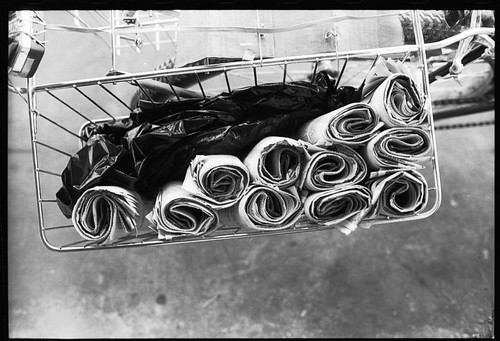
The paper bundle gets thrown out of the station wagon at just before six a.m. This was in the days when afternoon papers still existed. His grandparents subscribed to the morning paper and another in the afternoon. You read the morning paper before work over coffee and on the bus. The afternoon paper you read when you got home, maybe before dinner or after dessert. But on weekends, the afternoon paper - delivered after school on weekdays - arrives in a bundle at the paperboy’s house at six a.m. for morning delivery.
Hard now to imagine a world in which ordinary people read this much. Hard to imagine ordinary people expecting their weekend paper to arrive at seven a.m. so they could begin their busy weekend morning nearly before the sun. Did TV replace that, he wonders? All that reading? All that activity that was neither work, nor commerce? He remembers his own grandpa, building, building, ever hammering, painting, fixing. And cards at night with friends, his Honey and grandpa. And sure some TV then too, mostly “Bowling for Dollars” and national news. Hard now to imagine what other people’s grandparents were doing after they drank their coffee and read the paper at eight a.m. on a Saturday morning.
The paper bundle hits the sidewalk maybe a little early at five-thirty and what a boy about ten or so should be doing at that time of the morning: sleeping. The alarm goes off at 6am and he promptly turns it off and goes back to sleep. Just for a few minutes, please.
What drove his step-dad, he wonders, to take it upon himself to worry about the boy and his paper route, whether he was late or on-time, whether he appeared responsible or irresponsible? Such a mysterious other world view. A compulsion to instill certain values in our children, by hook or by crook. A fundamental misunderstanding about the nature of human nature and what motivates people. A generation of Dr. Spock behaviorists at war with all things natural.
At six-fifteen, dad wakes him up. Shaking the bed or his foot. “Get up,” he says, “Your papers are here.”
He stops for a moment digging. Rests his hands against the shovel. Looks at one hand and then the other. Not course and rough, like his grandpa's hands. But still, they have their scars and rough spots. Evidence of a life spent working in one way or another. "Honey?" a call from the house, a face looking out a window. He waves and smiles and gets a oh-there-you-are look, a smile in return.
A battle of wills, he guesses, is how step-dad must have seen it. He imagines him now, awakened by the slap of the bundle on the driveway. Lying in bed, wakeful, listening. The alarm goes off from the next room. Listening for feet hitting the floor, drawers opening, floorboards squeaking, a door. Hearing none of this, a familiar anger rising. A sense of frustration mixed with a hint of pleasure, like a tooth ache, a feeling of place and role and irresolute duty and knowing that every knock left or right puts the boy a little more in line. And dad knows, God, how he knows, from his own kids how little it takes for boys to get far off-course. Willpower and discipline and firm rules, all that separate kids from a tumble into the wrong path.
The next visit at six-thirty is less subtle, “Get up” and the covers come off. A little boy in PJs suddenly cold, suddenly awake, looking up startled, frightened, but with the merest trace of the defiant righteousness of someone who knows he is being bullied. Something he knows he’s carried right into adulthood.
“Okay, okay,” he says. “I’m getting up.” Step-dad waits silently, and the boy has to turn this concession into action and swing his feet to the floor before he leaves silently.
Six-thirty a.m. Nine months of the year, it’s still dark out. The boy rubs his eyes, tests his shaky legs. There’s a false promise on the air -- he thinks this every Saturday and Sunday morning -- that if he hurries through his route, he can go back to bed. It’s never happened and probably won’t. Because when he gets out on his bike early on a weekend morning out in the cool air, a whole free day ahead of him, the world is his oyster.
He remembers his ex-wife saying once as they were in the homestretch to a meltdown, "I don't know why you have all these projects, you never finish anything." A comment said with such ferocity and disgust that it made him uncertain for years. Now he looks back and sees such a stretch of things accomplished, ideas hatched, plans made, projects finished, that it makes him feel humble. A complicated proud and humble feeling. On good days, a feeling that he is merely a vessel of energy of which he has responsibility. Still, he thinks of this moment with his just-about-to-be ex-wife every time he finishes something. And here again, he wonders about Heisenberg.
But, oh, so many steps to go before he can ride. Put on warm clothes. Open the garage. Unbundle the papers with a little explosion as the plastic ribbon tie is released. Slide in any inserts. Saturday morning: no inserts. Sunday morning: more inserts than the rest of the week combined (excepting maybe Wednesday). The only consolation for this extra trouble, reading the Sunday funnies while he folds. Folding the papers. Saturday, the slim paper gets folded vertically into thirds. Sunday, it’s too big for this. The Sunday paper is folded once over horizontally, that is, folded in half parallel with the paper’s masthead. There’s a right way to do this, he thinks. The paper should be folded so the masthead itself is still visible. This has nothing to do with his feelings about the newspaper. It’s his own funny way of things. If you explain something to him, show him how to do something, and it seems to fit, you’ll never have to show him again. If your way is not quite right, the long way, wasteful of energy, unclear of reasons, awkward, there really isn’t much you can do short of a thrashing that can get this boy to do it your way. And he’ll say he forgot, and that isn’t completely untrue. He’s not willful quite, just something else. He knows he’s carried this trait right through to adulthood too.
The papers go in the bag, and the bag gets wrapped around the handlebars just so. The bags, the papers, the rubber bands, the inserts, the bike, these are tools of a sort of trade. All so familiar, like his left arm or pinky toe. He’s sure, even now, he could easily get on a bike. The weight of the paper, the subtle flick of the wrist could put a paper right next to someone’s door from ten yards away, these years later.
And closing the garage door and closing the gate, he’s off on his bike, sometimes with his dog chasing off in front, sometimes no, riding into adulthood with all its insecurity and independence.


Ocean voyages in far away lands
without ever seeing the sea
and trees, leaves, fall and autumn
colors breaking bones
Breakdown brakeshoe breakbeat
a backbeat an off rhythm
Snare player from the Midwest
in a Salvation Army coat
sees a girl he thinks he
recognizes from a 1000 miles away
An old love, a burnt out flame
Fists in hand, a baseball bat hidden
behind the seat, a host of empty 40s
clinking together at every light
A lady who smokes Tarringtons
skids to a halt beside a hitchhiker
but doesn't look at him as he gets into the car
says
"What's your story?
Are you going somewhere?
Or are you just going anywhere?"
The leaves from the sycamore float
to the ground
A Blizzard, a snowstorm of
amber and flame.
Snow drifts covering the walk of the Galleria
and a guy with a leaf blower
blows it all away
An open door, an unfinished song
Where does that take us, and what does it leave
Leaves, fallen, rotting, mulched in two weeks of
steady drizzle, an end of October gloom
first of November expectations
of a hard winter
A target, an open sore
bathed in antipathy, ambivalence, and four dollar scotch
A beer, a fear, total fakery
No guarantees, of course, but maybe a hope that something
anything
will come of this
this time.
Kind thoughts,
Good intentions.
I don't need safe and sane,
Right job,
Right life.
I was raised short on inspiration.
I was raised where books on shelves,
Where there were books,
Were Condensed Books
Like Condensed soup
Down to nothing at all.
Art was Tuesday's at one.
Music was radio.
Entertainment was TV.
I came from the dry side,
The sly slide of life
Into old age
The don't question
Don't look back
Side of it all.
Take for granted
If you will
The magic of music.
But I can't afford it.
Inspiration.
Irritation.
An oyster.
A pearl.
You inspire me.
I'm not sucking up.
Fucking up.
Trying to get something.
Trying to buy you
Or sell.
I don't want to fuck you.
And I don't give a goddamn
What you think.
Credit goes
When credit's due.
You can deflect what is good
And what is given.
You can hide from love
And hide from life.
But I want more.
More life.
More light.
More love.
And more fucking in elevators.
Light me on fire,
Or get the fuck out.
 A man sits at the curbside on his pack. He looks serenely into the blue sky. His sign says simply "Mercy." It was Superbowl Weekend I heard.
It got me thinking, of course. My true needs are simpler than I sometimes imagine. What would my sign scrawled on cardboard say?
The image of a peaceful corn field can sometimes make me cry. It's silly and I can't explain it. When I think about rest and my longing for it, tears well up in my eyes from missing.
That night, I took an inner tube down to the lake in the big sky blue truck. There was mirage on the road past the quarry. I walked out past the children splashing in knee-deep water. I waded out to the end of the flooded parking lot where I could feel the parking curb beneath my feet. I jumped into the tube and paddled out.
I splashed past the houseboats. I drifted beyond the moored motorboats. I sailed around the island that was part of the park before the high-water. I paddled backward out into the lake. The water was green glass.
The sun ducked behind a bank of clouds. Slowly the sky turned apocalyptic. The sun was blood red and hazy. The clouds swirled overhead.
I was alone on the big lake. Just me and the water bugs and the geese overhead. I lay my head back and watched the sky. I drank in the delicious lonely feeling of solitude and the bigness of the whole world.
On the way home, there was a line at the DQ in the twilight, and the bank thermometer read 94 degrees.
A Scene In Which Bay Reveals She Went to Morocco to Meet Paul Bowles
By Wes Modes on Thursday, September 04, 2008
It was an area left to its own devices. Rotting pilings, collapsing piers, concrete and fennel, warehouses left to the realms of rust and graffiti, the broken window, the gray heron. On the bay side, sunny when the rest of the city was shrouded in fog, massive dry docks, power co-generation, an electrical substation for much of the city. There were artist's studios tucked into crumbling century-old warehouses and galleries to which no one ever came, all the more hip for their delicate and rare, off-the-map obscurity.
Into this industrial and derelict labyrinth they made their way, roared actually, though the metaphor is not exactly apt, since the chopper carried two carefully reverent persons, parishioners in the church of rust and decay and broken concrete.
A new chain link gate, ridiculously high, topped with razorwire blocked the sea and its civic-designated dangers from the curious. And from the dozens of fishermen, Asian and Central American men, who pulled fish out of the heavy metal waters of the bay.
But fences, old ones, chain link ones, ones that protect us from ourselves are always porous. The trainyard, the abandoned factory; there are always holes worked into the fences, clever and person-sized holes behind bushes and worried into the seams and corners. This one was no exception and Bay and Rico set about undaunted and laughing to pour themselves through this barrier into the sea.
An unlocked gate. A fence flap secured with a single twist of baling wire. The sea. And endless armful of bay with surprisingly clear waters breaking gently over colorful gravel and concrete. "There's always a way," says Rico.
"I stopped growing at age eleven," says Bay, folding and unfolding herself through the cut in the chain link.
"Six foot in, what is that, fifth grade?" Couldn't have made the awkward years of junior high easier."
"Six one. No. Where are we going?"
"A place I've been. Maybe a year ago though last. It was easier. Fishermen. They come out here."
They walk to the end of a short pier and through the railing of another fence and then around clinging to a concrete ledge, back toward the shore, but on the other side of the fence now.
A long concrete pier far out into the bay is across a broad channel of water in the direction they are moving. The pilings have rotted beneath, dunking a portion of the pier. This section lies catywumpus at a forty-five degree angle, waves lapping freely at one edge. It challenges everything we know about civic institutions. It is precisely rotated forty-five degrees from okay, neither horizontal nor vertical, precarious and deadly looking. A rusty piece of half inch rebar or four inch welded wire holding it in place maybe. Perhaps nothing. Waiting. The weight of a person, two people maybe, making the difference. The collapse of a ten ton slap of steel reinforced concrete into the bay. There are already large portions of the old pier that are tellingly absent.
"Are we going there?" Bay gestures.
"Maybe. You wanna? Beautiful. Goes all the way out there."
"Um."
"We are motha fuckin' intrepid. We are intrepid motha fuckers." Rico leaps down to the debris strewn shore of the channel. "This is like 90% rust," he says standing on a red and flaky shape, once part of a ship maybe, now part of the beach, solidly embedded. Rico leaps from bulky shape to shape, alive in the feeling of muscles, childhood leaps from rock to rock on a rugged shore. "No, maybe 100% rust. What the fuck? What is beneath here?" Bay jumps down to the shore.
The smell of the sea, aging seaweed, salt tang, an unidentified base note beneath the surface. Later when they hug, Bay says, "You smell like sunshine." Rico doesn't know what she smells like. "You smell like, I don't know, you. Perfect." Spicy and warm and slightly sweet.
"Evan has no sense of smell," she says. "Isn't that the most tragic thing you've ever heard?"
"Tragic. He can't taste your food." He can't smell you.
Across the channel and up a fallen piling to the beginning of the collapsed pier. Through a fence and through a forest of fennel there is a warehouse over some distance of weedy concrete. "Ah, there," says Rico. There is a small hole cut in the fence just large enough for a small person.
"I come out here on a sunny day when I'm in the city. Smoke a cigar. Take off my shirt. Though I used to be able to drive in and park there.
Bay is quiet, and Rico is self-conscious. Always telling a story, talking into other people's silences, trying to ferret out their personal experiences by exposing his. A long discovered magic, strength through vulnerability. Courageous or compulsive. One or the other.
Bay, this quietly charismatic woman with a razor sharp intelligence behind big, liquid eyes. Seeing everything, watching, ever moving. A blur. Quiet? No, not really, but right now shy, perhaps. Or observing. Economical maybe, with just nothing to say in this moment. A place Rico, never lacking in words his whole life, finds himself with increasing frequency. Four decades and now he finds there are moments in which there is nothing that needs to be said.
Perhaps these moments were always there. This embarrasses him.
Rico wiggles through the hole in the fence. This big man squeezing through a little hole, turning his shoulders as he goes through feet first so they fit. Care taken with cut wire ends. "Reminds me of caving," he says. He reaches through and offers to take her bag which he does. Bay wiggles through, a tall lanky woman, with relative grace.
"It's beautiful," says Bay approaching the warehouse. "Graffiti. Broken windows." She looks up, around. Nearly every window is broken out, but not every one. How is it some have survived how many years of rock throwers?
"You've been here before," Bay looks at Rico with those deep blue eyes. Soft blue with a rim of dark around the iris. An open smile.
"On sunny days," he says, "I've always been here alone." He looks back trying to absorb this moment. Her pant leg is torn, revealing a deep scratch. She waves it off. "These jeans have seen better days."
The warehouse is a cathedral. A huge open airy space. This is a church God would approve of, if he existed. Floor to ceiling writing, pictures, names, scrawls all in bright colors. Windows from here to the far away rafters. Steel supports crisscross the walls. Broken glass bejewels the floor everywhere. Their feet make a hushed crunch. Gutter diamonds.
"A swing!"
"A piano!"
Indeed both. A rope swing hung from the high rafters, stories high. A fucked up piano with many missing keys. "Holy shit, this is cool," Rico runs with the swing and, kicking off a small skateboard ramp, takes off into the air.
Bay plays several out-of-tune notes. Rico runs from the swing to the piano. A little boy's excitement. He plays an impromptu concert with sticks directly on the piano harp, more percussive than melodic.
Bay pulls herself up on the swing, sitting on the bit of broken piano tied to the end. "Check it," she says swinging out into space. She is beaming. Light rays of joy spill out of her as she moves through the air. A tanktop, bare arms with a hidden strength beneath the skin. Rico gives her a big push, running beneath her. She captures him with her legs as she swings back.
Rico climbs up a ladder into the rafters. He swings down and runs to join Bay exploring the warehouse further.
She stands facing the sea. Part of the warehouse has lost its metal siding and the bay comes right to the concrete foundation. There are buildings, collapsed piers sunk in the water. A lost world of Atlantis right here in the city. Metal rooftops peaking from beneath the gentle waves.
The waters look so green and clear. The sunny day, the warm air. Bay extends her hand and Rico takes it. Or maybe it's the other way around. Not sure.
[audio http://www.archive.org/download/NightRide-V101-UrbanExploration/V101-urbanExplorationhour1_64kb.mp3|bgcolor=#B8B29A]Night Ride - V101 - Urban Exploration - hour 1
[audio http://www.archive.org/download/NightRide-V101-UrbanExploration/V101-urbanExplorationhour2_64kb.mp3|bgcolor=#B8B29A]Night Ride - V101 - Urban Exploration - hour 2

I slept in my truck the other night. With the drip drip drip of my leaking gas line, and the tick tick tick of my cooling engine after another five hundred miles, and the slow rrrrroar of passing semis on the highway, I slept in my truck.
And in the morning it was just too damned cold and too damned cramped to sleep another minute more, so I crept into the Ludlow Coffee Shop. It was a What Can I Getcha, Hon? sort of cafe. A biscuits and gravy sort of cafe. A bottomless cup of weak coffee sort of cafe. And while I sat inside, the desert rain came down outside.
I breezed out of the Ludlow Coffee Shop to a pleasant surprise: The whole world smelled like sage and creosote bush. I can't even begin, don't even know how to start to tell you what this was to me. It was a reunion. A love renewed. Sensual. Exhilarating. Full of life and wired joy. It was light rain drizzling down my neck, coffee warmth in my stomach, and full body chills.
I let the truck coast to a stop alongside a desert road. I got out and started walking. Rain was falling, light and feathery. The creosote bushes were sticky with resin and thick with desert fragrance.
I started collecting things white. Sand sculpted limestone. Sun-bleached bones. Milky quartz. Then I started collecting things black. Volcanic basalt fragments. Pieces of retread. Polished black stones.
I broke off a piece of creosote bush, crushed it between my palms, cupped my hands over my face, inhaled deeply.
A weathered piece of wood. A rusted piece of tin. An old hourglass-figured coke bottle half-filled with sand. I turned back to look at the truck more than a mile distant. It was a small sky blue speck resting on a rise against a heavy gray sky.
I picked through the washes and ran my fingers through the silky sand that gathers in the slow parts of the wash. I ran my hands over the desert pavement where the sand had been blown or washed away leaving behind a surface of small pebbles that neatly fit together like a jigsaw puzzle. I could barely turn back.
I flirted with the idea of just walking away. Leaving it all behind. They'd find my truck, keys still in the ignition. Find my cameras. Find all my camping gear. They'd find no sign of a struggle, no clue to my disappearance.
And I'd just keep walking, walking. Further and further away from everything.
(originally posted on the Spoon, in 1997)